
Get your SPOT Price with the COUPON we sent you:Indoor Floor Standing Kiosk

Dys
Hrs
Min
Sec
Flash
Sale

WHAT IS OPTICAL BONDING?

What is Optical Bonding?

Optical bonding is a technology that injects special glue in the display glass or touch screen and TFT liquid crystal (TFT) panel and coated with a layer of resin (OCR) or film (OCA), bonding into a solid laminate without gaps or bubbles. When selecting screens for any project, you should evaluate the environmental and operational conditions that screens will have to endure. Industrial-grade screen and panel PCs are rugged with all types of features and can withstand any type of application. One property that can be considered is optical bonding.

Optical bonding is widely used in the medical, military, transportation and retail sectors where higher performance displays are required due to harsh environments.  Optical bonding is suitable for industries that need to use robust displays in high reliability environments or need to use displays in high ambient light conditions.  The optical bonding process is particularly suitable and more efficient for equipment that operates outdoors or in bright light.
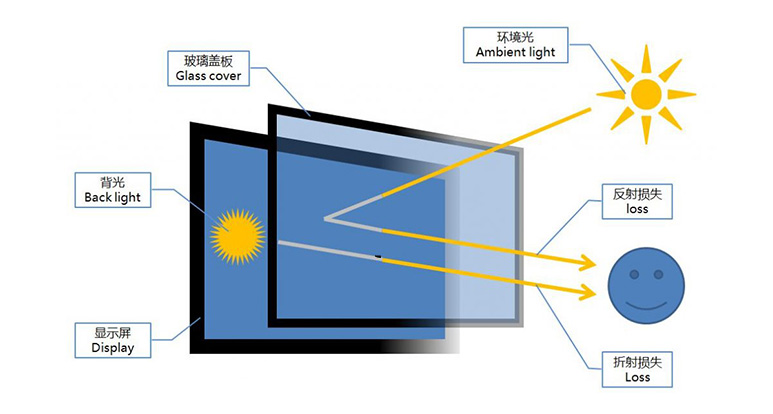
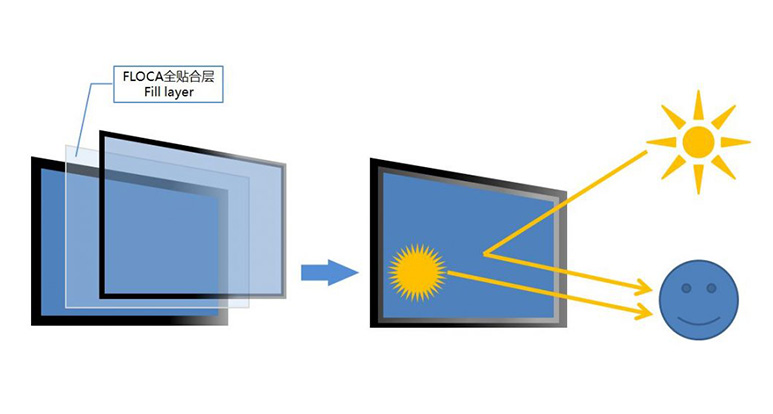
LOCA optical lamination fills the organic silicone between the LCD module and the touch screen which the light reflection loss is small. Therefore, the display screen has a higher contrast and superior display effect under the irradiation of ambient light. It effectively avoid condensation, dust or other impurities in the interlayer of the display screen.

Ambient light reflects after it reaches the display screen. The air in the middle of the traditional air gap bonding screen will cause the loss of light reflectivity. The higher the reflection loss, the lower the contrast of the display.

Optical Bonding VS Non-Optical Bonding
 

Share

More Technologies

Digital Signage 2026 New Technologies for Small and Large Format Displays

Digital signage is experiencing a new phase of acceleration. From compact countertop monitors to large-format window and wall displays, the goal is clear: communicate better—more brightly, reliably, and with easier management.   Today, companies are looking for solutions that truly operate 24/7, remain clearly visible in any lighting condition, and

Read more »

THE 5 TYPES OF TOUCH SCREEN TECHNOLOGY: A COMPLETE GUIDE

In the fast-evolving world of interactive technology, touch screen monitors are revolutionizing the way we interact with digital devices. From industrial applications to consumer electronics, the demand for reliable and efficient solutions is constantly growing. World Trade Display (WTD), a leading provider of high-quality touch screen solutions, presents a complete

Read more »

VIRTUAL DISPLAYS, THE NEW CULTURAL SHIFT

The future of television: toward virtual displays Technological and cultural evolution is pushing television beyond the limits of the physical screen. From old CRTs to LCDs and now to the latest OLEDs, the “TV” has always been tangible. Today, with the advance of augmented reality (AR), virtual reality (VR), and

Read more »

AUGMENTED REALITY IN THE DISPLAYS OF THE FUTURE

The world of displays and monitors is undergoing a profound transformation. Technological progress, combined with new market demands, is redefining the boundaries of the visual experience. From image quality to interactivity and environmental sustainability, every aspect is being reimagined to offer solutions that are increasingly advanced, connected, and intelligent. 1.

Read more »

The motherboard market is experiencing a sharp increase in costs, mainly driven by DRAM memory shortages and high chip prices, further aggravated by the surge in demand from the AI sector. This trend, expected to continue until 2028, has led to a significant drop in sales and is forcing a return to older technologies such as DDR4.

Below are the key details regarding the cost increase:

  • Main Causes: Strong demand for Artificial Intelligence (AI) components has led manufacturers to prioritize the production of high-capacity memory, resulting in shortages and higher DRAM costs, which directly impact motherboard prices.
  • Price Impact: Significant price increases are being observed, with some DDR5 kits exceeding USD 600. Analysts forecast a steady upward trend in the long term, estimated through 2028.
  • Market Situation: Rising RAM prices have caused a 40%–50% decline in motherboard sales, described in some sectors as a “memory apocalypse.”
  • Emerging Trends: There is renewed interest in older motherboards and memory technologies, such as DDR4,
    due to the prohibitive costs of next-generation platforms.

The situation is critical, with price increases affecting not only key components but the entire PC ecosystem as well, including motherboards, which are also being impacted by memory shortages. Accordingly, due to the ongoing increases in the cost of components and other materials, as previously communicated in our email since February, all prices agreed upon earlier and all quotations issued are no longer to be considered valid. Please contact our sales department for updated information and to confirm product availability.

The motherboard market is experiencing a sharp increase in costs, mainly driven by DRAM memory shortages and high chip prices, further aggravated by the surge in demand from the AI sector. This trend, expected to continue until 2028, has led to a significant drop in sales and is forcing a return to older technologies such as DDR4.

Below are the key details regarding the cost increase:

  • Main Causes: Strong demand for Artificial Intelligence (AI) components has led manufacturers to prioritize the production of high-capacity memory, resulting in shortages and higher DRAM costs, which directly impact motherboard prices.
  • Price Impact: Significant price increases are being observed, with some DDR5 kits exceeding USD 600. Analysts forecast a steady upward trend in the long term, estimated through 2028.
  • Market Situation: Rising RAM prices have caused a 40%–50% decline in motherboard sales, described in some sectors as a “memory apocalypse.”
  • Emerging Trends: There is renewed interest in older motherboards and memory technologies, such as DDR4,
    due to the prohibitive costs of next-generation platforms.

The situation is critical, with price increases affecting not only key components but the entire PC ecosystem as well, including motherboards, which are also being impacted by memory shortages. Accordingly, due to the ongoing increases in the cost of components and other materials, as previously communicated in our email since February, all prices agreed upon earlier and all quotations issued are no longer to be considered valid. Please contact our sales department for updated information and to confirm product availability.